
ACVO vs ECVO: Understanding Veterinary Ophthalmologist Credentials
The first time someone corrected me about ophthalmologist credentials, I was embarrassed. I had brought one of my Collies to a veterinary eye specialist — a very competent vet who had done plenty of eye exams — and assumed the result would be acceptable for OFA registration. It was not. The vet was not a diplomate of the American College of Veterinary Ophthalmologists, and OFA would not accept the exam.
That lesson cost me two trips to a clinic event and several weeks of delay. It also gave me a thorough education in veterinary ophthalmology credentialing, which I am passing along here so you do not repeat my mistake. Understanding credentials is essential before you find a qualified ophthalmologist for your certification exams.
What Board Certification Means
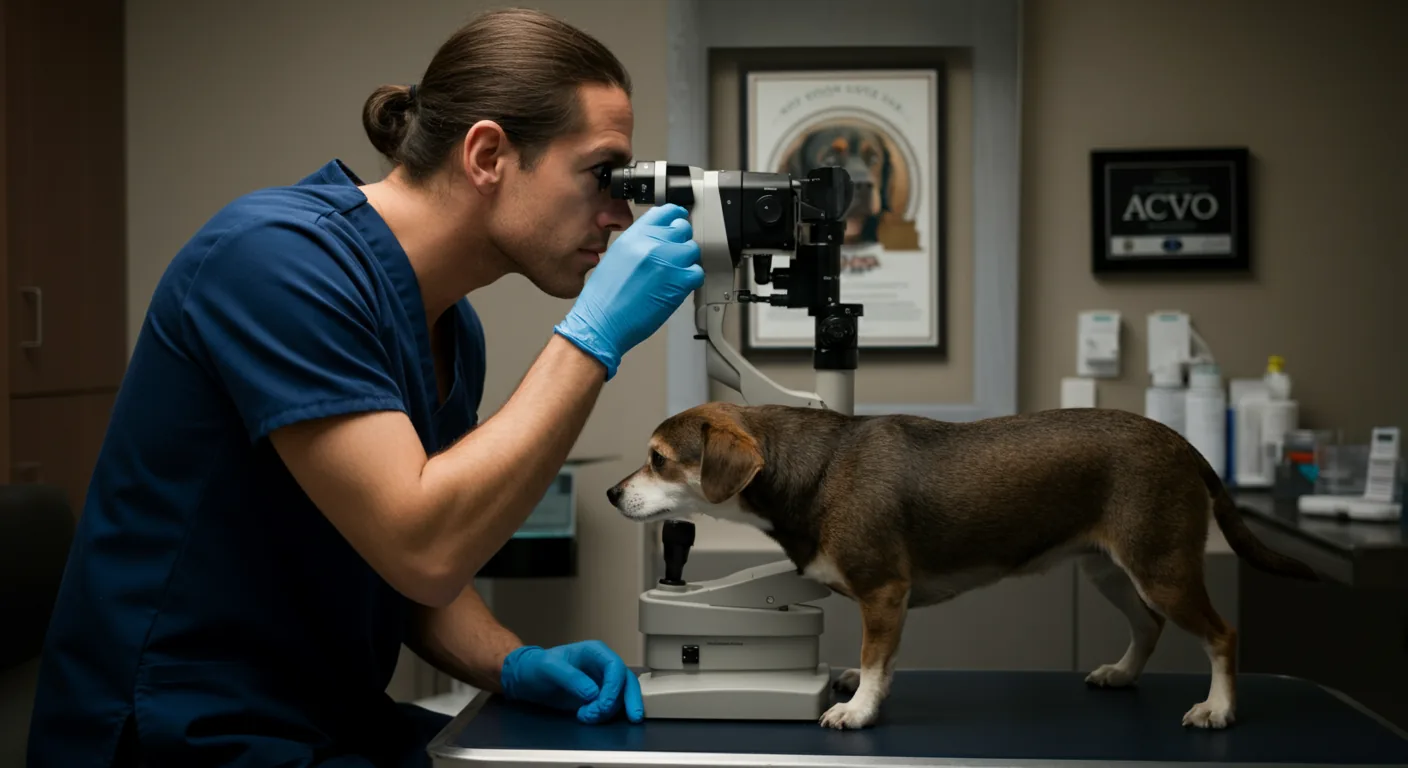
Veterinary medicine, like human medicine, has specialty boards that certify practitioners who have completed advanced training in a specific discipline. Board certification is not just an additional degree. It requires completing a residency program at an approved institution, passing comprehensive written and practical examinations, and demonstrating competency to a committee of peers.
For veterinary ophthalmology in the United States, the governing body is the American College of Veterinary Ophthalmologists, abbreviated ACVO. Veterinarians who complete all ACVO requirements earn the title Diplomate, ACVO. You will see this written after their name as Dipl. ACVO or DACVO. This is the credential OFA requires for eye certification exams.
In Europe, Canada, and many other countries, the equivalent credential is awarded by the European College of Veterinary Ophthalmologists, abbreviated ECVO. ECVO diplomates can perform OFA-accepted examinations for dogs based in those regions.
For OFA eye certification, your examiner must be a Diplomate of either ACVO or ECVO. No exceptions. A veterinarian who is very good at eyes but lacks this credential cannot perform a certifiable OFA exam.
The Path to ACVO Diplomate Status
Becoming an ACVO diplomate takes roughly five to seven years after veterinary school. First, the candidate completes a one-year rotating internship in small animal or mixed practice. Then they enter a three-year residency program in veterinary ophthalmology at an approved academic or private practice program. Residencies are competitive, and there are limited slots available nationally each year.
After completing the residency, the candidate must pass a certifying examination that includes written and clinical components. The examination tests knowledge of ocular anatomy and physiology, hereditary diseases, medical and surgical treatment, and clinical examination techniques. Pass rates for first-time takers have historically been around 60 to 70 percent, which reflects how demanding the examination is.
Continuing education requirements keep diplomates current with advances in the field. So when you see DACVO after a veterinarian's name, that represents years of specialized training and ongoing education, not just a certificate from a weekend course.
ECVO Credentialing Process
The European College of Veterinary Ophthalmologists has a parallel process for European-trained veterinary ophthalmologists. ECVO residency programs are typically three years and based at European veterinary schools or approved private practices. The ECVO diplomate examination covers similar content to the ACVO examination and is considered equivalent for OFA purposes.
ECVO diplomates are most relevant if you are breeding overseas or importing dogs from European programs. Many European breed clubs and kennel clubs accept ECVO examinations for their own certification requirements. If you breed with European lines, understanding ECVO credentials helps you evaluate the eye health documentation that comes with imported dogs.
Why Only Diplomates Can Certify
The requirement for board-certified ophthalmologists is not bureaucratic gatekeeping. It exists because accurate identification of hereditary eye disease requires exceptional skill and highly specialized equipment. The indirect ophthalmoscope, slit lamp biomicroscope, and indirect examination techniques needed for a thorough eye exam are not standard veterinary tools and require years of training to use properly.
Many hereditary conditions look subtle or similar to other findings. Early cataracts can be missed or misinterpreted. Mild Collie Eye Anomaly lesions require a practiced eye to identify. Gonioscopic examination of the drainage angle requires specific training. A general practitioner who does eye exams regularly might catch obvious problems but will miss subtle hereditary findings that a diplomate would identify immediately.
The validity of the entire eye certification system depends on consistent, expert examination. OFA's requirement for ACVO or ECVO diplomates is what makes a passing result meaningful.
How to Verify Credentials Before Booking
The ACVO maintains an online directory at acvo.org that lists all diplomates by state and country. Before booking an exam, look up your examiner in the directory and confirm they appear as an active diplomate. The directory also shows their practice location, which helps you confirm you have the right person. If your examiner is European-trained, the ECVO publishes its own diplomate register at ecvo.org, where you can verify current ECVO status the same way.
You can also simply ask the veterinary practice directly: Is Dr. [Name] a Diplomate of the American College of Veterinary Ophthalmologists? Any practice that employs ACVO diplomates will be proud to confirm this and may even display the credential prominently in their marketing materials.
Clinic events at dog shows sometimes bring in examiners who travel specifically for the event. Before attending, contact the show secretary or breed club organizing the clinic to confirm that the examiner's credentials are current and verified. Details on getting the most value from these events are in the eye clinic events guide.
Diplomate vs. Veterinary Ophthalmologist: Confusing Terminology
Here is a terminology trap that catches breeders regularly. Legally, the term veterinary ophthalmologist is not restricted in most jurisdictions. Any veterinarian who does eye work might call themselves a veterinary ophthalmologist or describe their practice as ophthalmology. The restricted term is Diplomate, ACVO. That is what OFA requires.
I have seen clinic advertisements that describe services from a veterinary ophthalmology specialist without mentioning ACVO credentials. When I inquire further, I sometimes find these are vets with extra interest or experience in eyes, but not board-certified. Their exams may be excellent clinically, but they do not produce certifiable OFA results.
When in doubt, ask specifically: Are you a Diplomate of the American College of Veterinary Ophthalmologists? A yes or no answer to that specific question eliminates ambiguity.
What Happens If You Use an Unqualified Examiner
If you submit eye exam results to OFA from a non-diplomate, OFA will reject the submission. You will receive a letter or email explaining that the examiner is not on the approved list, and your registration fee will not be processed. You then need to repeat the exam with a qualified examiner, paying again.
More frustrating is the delay. If you are trying to certify a dog before a planned breeding, an invalid exam can push back your timeline by weeks. This is why verifying credentials before your appointment is worth the two minutes it takes to check the ACVO directory.
I learned this the hard way in 2003 when a colleague recommended an ophthalmologist who had just moved into our area. He had not yet appeared in the ACVO directory, and I assumed his credentials were in order because he came well recommended. They were — he was a fully certified DACVO — but my submission was initially questioned because OFA's records had not been updated with his new address. A phone call sorted it out, but it added three weeks to the process.
Residency Training Clinics
Veterinary schools with ophthalmology residency programs offer another option for eye exams. Residents in training perform exams under the direct supervision of ACVO diplomate faculty. OFA accepts exams performed by residents when a supervising diplomate is present and signs off on the examination. These university clinics can be excellent resources, particularly in areas with limited private diplomate availability.
Contact your nearest veterinary school's ophthalmology department directly to ask about their certification exam services. Many offer competitive pricing and can see multiple dogs on the same appointment if you are certifying several animals from your kennel.
ACVO = American College of Veterinary Ophthalmologists (US/Canada). ECVO = European College of Veterinary Ophthalmologists (Europe). Both are accepted by OFA. Both require years of residency training and rigorous examinations. Neither title can be used without completing all requirements.
After Verification: What to Expect
Once you have confirmed your examiner holds current ACVO or ECVO diplomate status, the certification process is straightforward. Read the complete guide to the eye exam process so you know what to expect on the day of the appointment, and review how to prepare your dog for the best possible exam experience. A prepared owner and a well-prepared dog make the examination faster and more thorough.