
Gonioscopy and Goniodysgenesis: The Overlooked Eye Certification Breeders Need to Understand
Most breeders I know can recite the OFA eye examination process from memory, but very few can describe what a gonioscopy is or why their Flat-Coated Retriever, Basset Hound, or American Cocker Spaniel may need one in addition to the standard annual eye certification. Gonioscopy examines a specific anatomical structure that the standard slit-lamp examination cannot visualize: the iridocorneal drainage angle. In breeds predisposed to primary angle-closure glaucoma, the findings of a gonioscopy determine whether the dog is at high risk for vision-threatening disease — and whether the dog should be bred.
I first learned about gonioscopy in 2009 when a judge pulled me aside at a specialty show and asked whether any of my collies had been goniographed. I had to admit that I had no idea what he meant. That conversation began a long education that I am now passing on, because gonioscopy is one of the most important supplementary eye examinations for the breeds it affects, and it is vastly under-utilized.
The Anatomy: Why the Drainage Angle Matters
The eye produces a fluid called aqueous humor continuously. This fluid must drain out of the eye at the same rate it is produced, or pressure inside the eye rises. The primary drainage pathway is the iridocorneal angle, a region where the cornea and the iris meet and where fine mesh-like tissue (the pectinate ligament and trabecular meshwork) allows fluid to exit into the venous system.
When this drainage tissue is malformed — a condition called pectinate ligament dysplasia or goniodysgenesis — fluid cannot exit the eye efficiently. Pressure rises, sometimes acutely and painfully, and the optic nerve is damaged by the elevated pressure. This is primary angle-closure glaucoma, and it is one of the leading causes of acquired blindness in predisposed breeds. Breeds with documented goniodysgenesis risk include the American Cocker Spaniel, Basset Hound, Flat-Coated Retriever, Welsh Springer Spaniel, Great Dane, Bouvier des Flandres, and several Northern breeds.
How Gonioscopy Is Performed
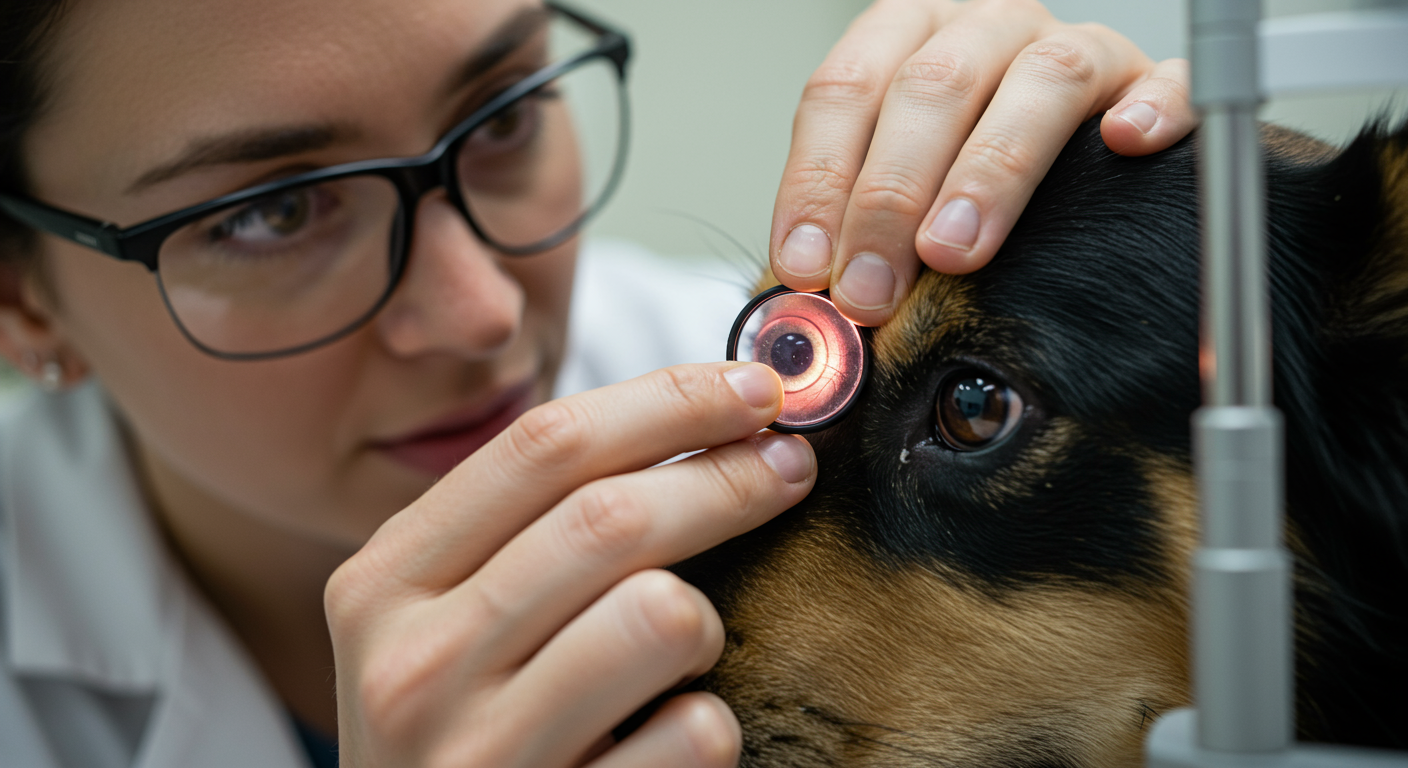
A standard slit-lamp examination cannot see the iridocorneal angle because the curved corneal surface bends the light path. Gonioscopy solves this by placing a specialized contact lens on the corneal surface. The lens uses either mirrors (Goldmann-style) or a spherical surface (Koeppe-style) to redirect the optical path so the ophthalmologist can see directly into the drainage angle.
The procedure takes approximately 3 to 5 minutes per eye after the slit-lamp is set up. Topical anaesthetic eye drops are applied, the gonioscopy lens is placed gently on the cornea with a coupling gel, and the examiner evaluates the pectinate ligament structure around the full circumference of the angle. The procedure is painless, though some dogs dislike the lens-on-eye contact and may need mild sedation.
Goniodysgenesis Grading
International standards, particularly those established by the European College of Veterinary Ophthalmologists and the BVA/KC/ISDS scheme in the United Kingdom, grade the pectinate ligament on a scale reflecting the severity of abnormality. The grading describes what percentage of the angle shows abnormal mesh structure.
| Grade | Percent of Angle Affected | Breeding Guidance (ECVO) |
|---|---|---|
| Grade 0 (Unaffected) | 0% | Acceptable to breed, regardless of mate grade. |
| Grade 1 (Mild) | Less than one third | May breed only to Grade 0. Never to Grade 2 or 3. |
| Grade 2 (Moderate) | One third to two thirds | Should not be bred in most breed club recommendations. |
| Grade 3 (Severe) | Greater than two thirds | Not bred. At high risk for glaucoma. |
Because goniodysgenesis progresses with age in some breeds, some schemes require re-examination before each breeding rather than relying on a single juvenile screening. The retest timing guide covers the annual certification cadence generally; breeders of glaucoma-prone breeds should add gonioscopy to that schedule.
Where Gonioscopy Fits in the OFA Framework
OFA does not issue a stand-alone gonioscopy certification in most breeds, but the OFA eye certification form has a dedicated section for angle abnormalities. When an ACVO diplomate performs a full eye certification including gonioscopy, the findings appear on the standard eye certificate. In some European schemes, gonioscopy is a separately issued document. For breeders navigating international pedigrees, understanding both recording conventions matters.
Not every ACVO diplomate performs gonioscopy routinely. The technique requires specific training and specific equipment. Breeders whose breed is on the goniodysgenesis risk list should confirm with the examiner in advance that gonioscopy will be included. The finding a qualified ophthalmologist guide covers the due-diligence steps for selecting an examiner.
DNA Testing and Gonioscopy
Unlike PRA and CEA, goniodysgenesis does not yet have a validated commercial DNA test for most affected breeds. Research in Flat-Coated Retrievers and American Cocker Spaniels has identified candidate genomic regions, but no pan-breed DNA test has been released that reliably predicts goniodysgenesis grade. Until such a test exists, gonioscopy remains the only reliable screening modality.
This absence of DNA alternatives makes gonioscopy especially important. For conditions covered by both DNA and clinical testing, a responsible breeder can build a breeding decision on the DNA result with clinical testing as confirmation. For goniodysgenesis, the clinical examination is the only tool. See the DNA vs clinical comparison for the broader logic of when each modality applies.
When Goniodysgenesis Becomes Glaucoma
The reason breed clubs take goniodysgenesis seriously is that the condition predicts glaucoma, not that goniodysgenesis itself causes visual impairment. A dog with Grade 3 goniodysgenesis may live a full and comfortable life with no glaucoma at all. Another dog with Grade 3 goniodysgenesis may develop acute angle-closure glaucoma at age six and be blind within hours without emergency treatment.
This unpredictability is precisely why the breeding guidance is strict. Breeding Grade 3 dogs produces offspring at elevated risk of an unpredictable, painful, and irreversible vision-threatening disease. The cataracts guide discusses a comparable case where breed-specific testing reshaped the breeding decisions of entire populations over a generation. Goniodysgenesis management follows the same model.
Documentation for Puppy Buyers
Breeders of predisposed breeds should provide gonioscopy results alongside standard eye certifications in the puppy package. New owners of predisposed breeds should know that their dog's breed has elevated glaucoma risk, what the warning signs are, and that sudden ocular pain, cloudy cornea, or visible distress around the eye is a veterinary emergency. This information should accompany the standard eye certification documentation.