
White Shepherd Health Beyond the Eye Exam: Deafness, Drug Sensitivity and the Rest of the File
A puppy buyer asked me last spring whether a white shepherd "comes with more problems" than a colored one. The honest answer is no, with a footnote that matters: the white coat itself is cosmetic, but the breeds that carry it share a health file that goes well past the eye papers. Deafness linked to pigment cells in the inner ear, a drug sensitivity mutation, a late-onset spinal cord disease, a pancreas that can quietly stop doing its job, a swallowing disorder, a form of dwarfism and a bleeding disorder all belong on the same checklist, and none of them shows up on an eye certificate.
This article lays out that checklist the way I keep it for my own dogs: what each condition actually is, which test detects it, and where it sits next to the annual eye exam. The genetics of the white coat itself, the e/e genotype and the myths that still circulate about it, are mapped in detail at coat color genetics for white shepherds, which is worth reading before this page because half the health rumors about white dogs start as color rumors.
One thing to keep straight throughout: a clinical exam and a DNA test answer different questions, which is the whole argument of our guide to DNA testing versus clinical exams. Most of the conditions below live on the DNA side of that line.
Deafness and the Cochlear Melanocyte Question
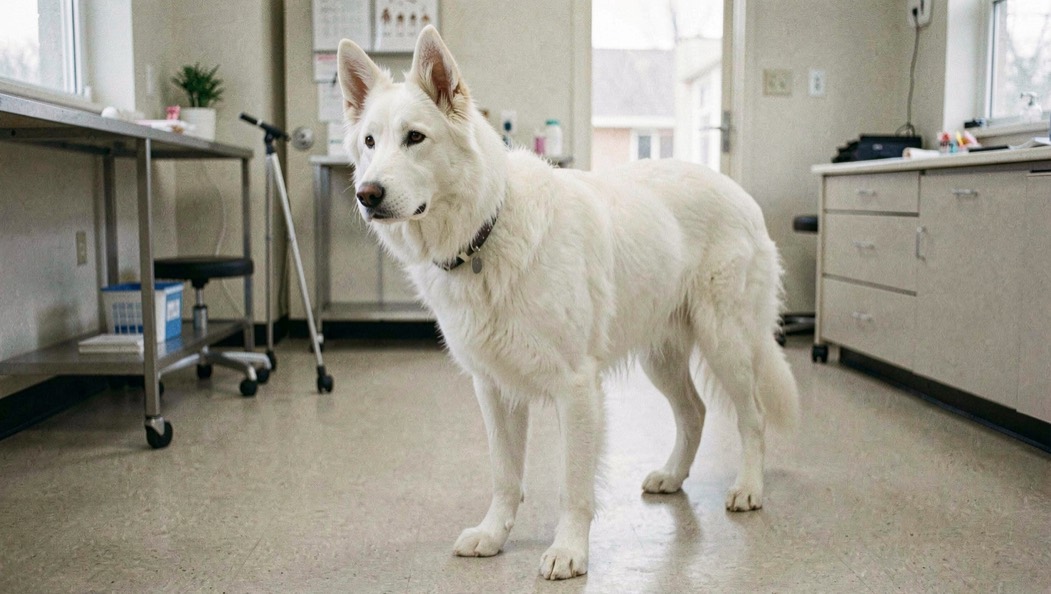
Congenital deafness in dogs tracks with pigment, not with color preference. The cells that matter are melanocytes inside the cochlea, specifically in the stria vascularis, where they maintain the ion balance the inner ear needs to function. When those melanocytes are absent, the cochlea degenerates within the first weeks of life and the puppy is born deaf or becomes deaf before it would ever be noticed at a routine vet visit.
The pattern is strongest in breeds with extreme white patterning, dogs with merle crosses bred to merle, and predominantly white-headed animals. In German Shepherd and White Shepherd lines, unilateral or bilateral deafness shows up often enough that a BAER test belongs in the file for any breeding dog. The Brainstem Auditory Evoked Response test is objective: it measures the electrical response of the auditory pathway and produces a pass or refer result per ear, not a guess from watching whether a puppy looks up when you clap.
A BAER result belongs next to the eye certificate for a simple reason: both are single-purpose clinical findings that buyers and breeding partners can verify. I treat "hearing tested" claims the same way I treat "health tested" claims, which means I want the name of the test, the date, and the result per ear.
White Is Not Albinism
This confusion causes more bad breeding conversations than any other item on the list. Albinism means an absence of pigment everywhere: white hair, pale eyes, pink nose, pink skin. A white German Shepherd or Berger Blanc Suisse has dark eyes, a black nose and dark-pigmented skin under the coat. The white hair comes from a recessive genotype at the Extension locus, the e/e pairing that switches the visible coat to white without touching pigment production elsewhere.
The distinction is not academic. Albinism correlates with light sensitivity and skin vulnerability; the e/e white coat does not. When someone tells you a white shepherd is "basically albino" and therefore fragile, they are repeating a myth. The genuine health questions for these dogs are the inherited conditions below, which exist independently of coat color.
MDR1 Drug Sensitivity
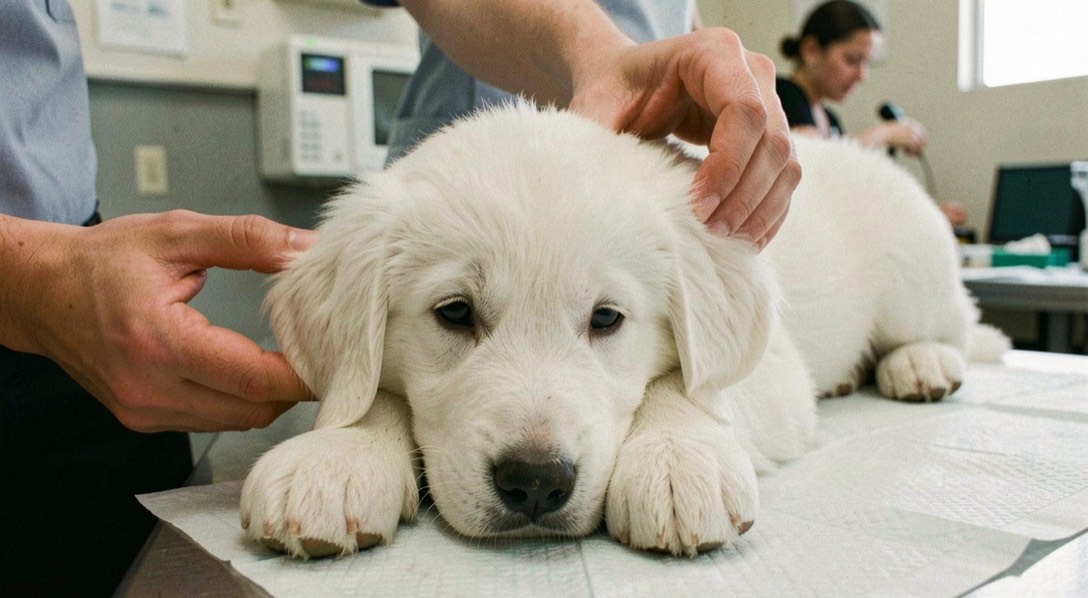
The multidrug resistance mutation, technically an ABCB1 gene defect, removes a protein that normally pumps certain drugs back out of the brain. Dogs with two copies of the mutation can suffer severe neurological reactions to drugs that are routine elsewhere: ivermectin at higher doses, loperamide, some sedatives and chemotherapy agents. Herding breeds carry the mutation at the highest rates, and shepherds sit inside that risk group.
The test is a cheek swab or blood draw, once per lifetime, because a genotype does not change. The reference laboratory for MDR1 testing in the United States is the Washington State University veterinary clinical pharmacology lab, which also maintains the list of drugs to avoid or use with caution for affected dogs. Every shepherd owner should know the dog's MDR1 status before the first surgery, because the answer changes which drugs the vet reaches for.
Degenerative Myelopathy and the SOD1 Test
Degenerative myelopathy is a progressive spinal cord disease of older dogs, most associated with German Shepherds and their close relatives. It begins as hind-end incoordination and knuckling, progresses to dragging and eventually paralysis, and it is painless, which makes it easy to miss in the early stages when owners assume the dog is simply slowing down.
A mutation in the SOD1 gene accounts for most cases, and a DNA test sorts dogs into clear, carrier and at-risk categories. Two carriers bred together can produce at-risk puppies, which is why the result matters at the pairing stage rather than after symptoms appear. An at-risk dog may still live its whole life without clinical disease, so the test is a probability statement, not a verdict, and I weigh it exactly the way I weigh an eye finding: as one input, not the whole dog.
Exocrine Pancreatic Insufficiency
German Shepherds are overrepresented for exocrine pancreatic insufficiency, a condition where the pancreas stops producing enough digestive enzymes. The dog eats normally or ravenously but loses weight, produces voluminous loose stools, and gradually declines because the food is passing through undigested. The diagnosis is a straightforward blood test measuring trypsin-like immunoreactivity.
Treatment is enzyme powder on every meal for life, and managed dogs do well. The breeding relevance is that EPI has a hereditary component, so it belongs in the health record you keep on a line, and in the honest answers you give a buyer who asks what has shown up in your pedigrees.
Megaesophagus
Megaesophagus is a loss of esophageal motility: the tube between mouth and stomach stops moving food downward, and the dog regurgitates meals. Regurgitation is not vomiting, and confusing the two delays diagnosis. The danger is aspiration pneumonia, which is the common cause of death in affected dogs.
The condition can be congenital, showing up as puppies wean onto solid food, or acquired later in life secondary to other disease. Management is mechanical rather than surgical: upright feeding, a Bailey-style chair or elevated position held after meals, and food consistency adjusted to the individual dog. It is the item on this list most likely to be missed on a pedigree because mildly affected dogs are quietly managed rather than declared.
LHX3 Dwarfism
Pituitary dwarfism in German Shepherd lines is caused by mutations in the LHX3 gene, which is required for normal pituitary development. Affected dogs fail to produce adequate growth hormone and other pituitary hormones. The result is a proportionate dwarf: a dog that keeps a puppy coat, grows slowly, and develops skin and organ problems because several hormonal axes are underpowered at once.
A DNA test for the LHX3 mutation exists and identifies carriers, which is the useful category for a breeder. Carriers are normal dogs that can produce affected puppies when paired with another carrier. This is the same inheritance logic as PRA carrier management: you do not discard a good carrier, you choose its mate.
Hemophilia A
Hemophilia A is a Factor VIII clotting deficiency carried on the X chromosome. Males who inherit the mutation are affected; females who inherit one copy are carriers. The disease shows up as prolonged bleeding after surgery, injury, or whelping, and mild cases can go unnoticed until a routine procedure turns dangerous.
For a breeding program, the practical questions are which bitches are carriers and whether any male puppy in a litter should be placed as a pet rather than a prospect. Carrier females produce, on average, half affected sons. A breeder who has seen unexplained surgical bleeding in a line should have the clotting workup conversation with their veterinarian rather than treating each incident as bad luck.
How the File Comes Together
None of these conditions competes with eye certification. They stack. A complete white shepherd health file holds a current OFA eye exam, a BAER result, and a DNA panel covering at minimum MDR1, SOD1 degenerative myelopathy and LHX3, with EPI and megaesophagus recorded as clinical history rather than genotype. The file is the product, not any single page of it.
That is also how I would read another breeder's paperwork. A seller who can produce the eye certificate but has never heard of MDR1 or BAER has an incomplete file, the same way a buyer who only asks about hips is asking an incomplete question. Our guide to genetic counseling in the certification process covers how to fold these results into a breeding plan, and managing health records across generations is the long-view version of the same discipline.
The white coat is not the problem and it is not albinism. The file that matters is pigment-linked deafness verified by BAER, MDR1 drug sensitivity, SOD1 degenerative myelopathy, EPI, megaesophagus, LHX3 dwarfism and hemophilia A. Every item has a test or a documented clinical history, and all of it sits beside the annual eye exam, not inside it.