
International Canine Eye Certification Standards: A Breeder's Guide
In 2015, I imported a Rough Collie from a Swedish breeder with an outstanding reputation. Her dogs had been certified through the Swedish Kennel Club's eye screening program, which uses ECVO-certified examiners and is well-respected in Scandinavia. When I tried to use those records to satisfy OFA requirements for my breeding program, I spent a frustrating week learning about the differences between international certification systems.
International breeding is increasingly common, and breeders who import dogs or export puppies need to understand how different countries approach eye certification. This guide covers the major systems, how they compare to OFA, and what documentation to request when crossing borders.
Crossing a border with a dog is paperwork of the same family as crossing it with a shotgun, and readers who drive north will find the same discipline in our note on hunting seasons and licences in northwestern Ontario, from Outdoors Cards to firearm declarations.
The OFA System: United States Standard
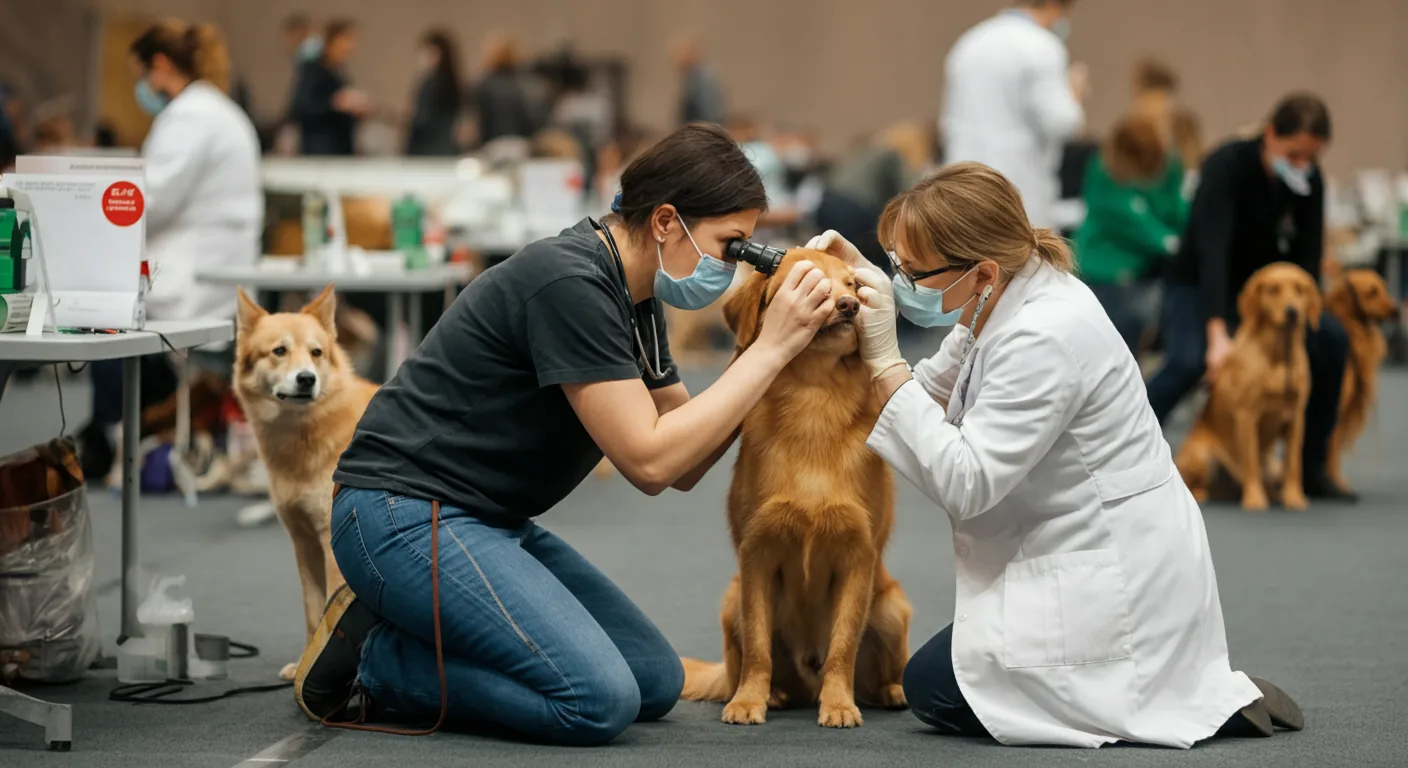
The Orthopedic Foundation for Animals Eye Certification Registry is the dominant system in the United States. It replaced CERF in 2012 and has become what most US breed clubs and kennel clubs expect. OFA requires examination by an ACVO diplomate, charges a $15 registration fee, and maintains an online searchable database. Certifications are valid for twelve months.
The history of this transition from CERF is covered in detail in the OFA vs CERF comparison. For US-based breeders, OFA is the straightforward choice, and most of this site focuses on OFA as the primary reference point.
ECVO: The European Standard
The European College of Veterinary Ophthalmologists administers eye certification programs across Europe through national kennel clubs. Most European countries have ECVO-certified examiners who perform examinations using the same protocol as ACVO examinations in the US. The examination itself — indirect ophthalmoscopy and slit lamp biomicroscopy after pupillary dilation — is essentially identical.
The key difference is the administrative structure. In Europe, examination results typically go to the national kennel club database rather than a pan-European registry. The Swedish Kennel Club, the Finnish Kennel Club, the Dutch Kennel Club, and others each maintain their own databases. This means that European eye health records are fragmented across national systems rather than centralized in one place like OFA.
OFA accepts ECVO examinations as equivalent to ACVO examinations for the purposes of OFA registration. If you import a dog with ECVO examination records, you can typically use those records to establish OFA registration by contacting OFA directly and providing the examination documentation. The process is not instant but is generally straightforward.
BVA/KC Eye Scheme: United Kingdom
The British Veterinary Association and The Kennel Club jointly operate the BVA/KC Eye Scheme, which has been the UK standard for canine eye certification since the 1960s. This is one of the oldest organized eye certification programs in the world, predating both CERF and OFA. The BVA/KC scheme uses BVA-approved ophthalmologists and maintains its own schedule of breed-specific conditions for which examination results are recorded.
BVA/KC certificates follow a different format from OFA results. The examiner records findings on a standardized BVA form, one copy goes to the dog's owner and another goes to the BVA central records. The scheme publishes breed statistics based on aggregate results, which provides useful population-level data about hereditary eye disease prevalence in UK breeding populations.
When importing dogs from the UK, request the original BVA/KC eye certificate and any supplementary records. These results are not automatically transferable to OFA registration but can often be used to establish a history alongside new OFA examination. If the dog was examined by an ECVO diplomate under the BVA/KC scheme, that examination may be more directly applicable to OFA registration.
Germany and the VDH System
The German Kennel Club, known as the Verband für das Deutsche Hundewesen or VDH, coordinates eye health certification for German-registered dogs through breed club-specific protocols. Many German breed clubs have requirements that are at least as stringent as OFA requirements, and some are considerably more so for breeds where Germany has historically invested heavily in health testing.
German Belgian Shepherd (Malinois) and German Shepherd breeding programs often include detailed eye certification requirements alongside hip and elbow evaluations. Breeders importing German working dogs will encounter breed club health certificates that include eye exam results. Look for ECVO examiner credentials on any German eye exam documentation.
Australian National Kennel Council
Australia administers eye certification through ANKC-affiliated breed clubs, using veterinary ophthalmologists recognized by the Australian College of Veterinary Scientists. The ACVS ophthalmology chapter credential in Australia is considered equivalent to ACVO for OFA purposes. Australian eye records use a format similar to BVA/KC documentation.
Breeders importing Australian working dogs — particularly Border Collies, Australian Cattle Dogs, and Australian Shepherds — will encounter ANKC eye records. When in doubt about equivalency, contact OFA directly before importing and ask which documentation they will need to process registration.
FCI Countries and the International Framework
The Fédération Cynologique Internationale is the international umbrella organization for kennel clubs in over ninety countries. FCI member countries generally accept each other's kennel club registrations, and most FCI national clubs use ECVO-trained ophthalmologists for eye certification. However, the specific requirements vary by country and breed.
For FCI-registered dogs from countries with active ECVO examination programs, the examination records are typically usable for OFA registration with appropriate documentation. For countries where ECVO examination is less common or where local veterinary standards differ, more investigation may be required before importing.
What to Request When Importing
When you import a dog with existing eye health records, request the following documentation as a minimum:
- Copies of all eye examination certificates with examiner name and credentials clearly visible
- Documentation of the examiner's ECVO, ACVO, or national equivalent certification
- The specific conditions examined and the results for each condition, not just a summary pass/fail
- Contact information for the examiner in case OFA requires verification
- The dog's complete registration documentation from the country of origin
Bring all of this to your first OFA eye certification appointment in the US and discuss it with the examiner. Having a new OFA examination performed shortly after importation is generally advisable regardless of what foreign records show, both to establish a US-based record and to give you a baseline in the OFA system going forward.
Exporting Puppies: What Foreign Buyers Need
If you sell puppies to buyers in other countries, research the eye certification requirements in the destination country before the puppy leaves. A US-born puppy with OFA certification is well-documented for US purposes but may need additional documentation for registration in European or other international registries.
Many European breed clubs will accept OFA examination results if performed by an ACVO diplomate, because ACVO is recognized as equivalent to ECVO. However, the format of the documentation matters, and some national clubs have specific paperwork requirements that OFA results do not automatically satisfy. Contact the relevant breed club in the destination country before the puppy ships to clarify what documentation they need.
Understanding what documentation puppy buyers should receive gives you a framework for what to provide. For international placements, add a section that addresses the destination country's specific requirements.
Using International Records in Multi-Generational Analysis
Pedigrees increasingly span multiple countries, and evaluating the eye health history of imported breeding stock requires understanding different certification systems. A French dog with ECVO certification, a UK dog with BVA/KC records, and an American dog with OFA records all represent valid eye examinations despite the different administrative systems.
When reviewing pedigrees with international records, look for the underlying examination — indirect ophthalmoscopy by a board-certified ophthalmologist. If the examination was performed competently by a qualified professional and documented in a reputable national registry, the substantive health information is comparable regardless of which system administered it. The managing eye health across generations guide discusses how to integrate this kind of mixed documentation into a coherent breeding program health picture.
International eye certification systems differ administratively but use essentially equivalent examination protocols when performed by ACVO or ECVO diplomates. Documentation format and registry requirements differ. When in doubt about equivalency, contact OFA directly before importing or beginning international breeding.